Research Article | Open Access
|
Open Access
|


 | Published online: 30 March 2026
An AI-Driven Training and Placement Platform with Predictive Analytics and Conversational Assistance
| Published online: 30 March 2026
An AI-Driven Training and Placement Platform with Predictive Analytics and Conversational Assistance
Srikar Kulkarni,* Vaishnavi Kamthe, Kumar Saransh, Nemat Momin, Sonali Shirke and Mukul Jagtap
Department of Computer Engineering, Keystone School of Engineering, Pune, Maharashtra, 412308, India
*Email: srikarkulkarni49@gmail.com (S. Kulkarni)
J. Smart Sens. Comput., 2026, 2(1), 26204 https://doi.org/10.64189/ssc.26204
Received: 30 January 2026; Revised: 20 March 2026; Accepted: 27 March 2026




Abstract
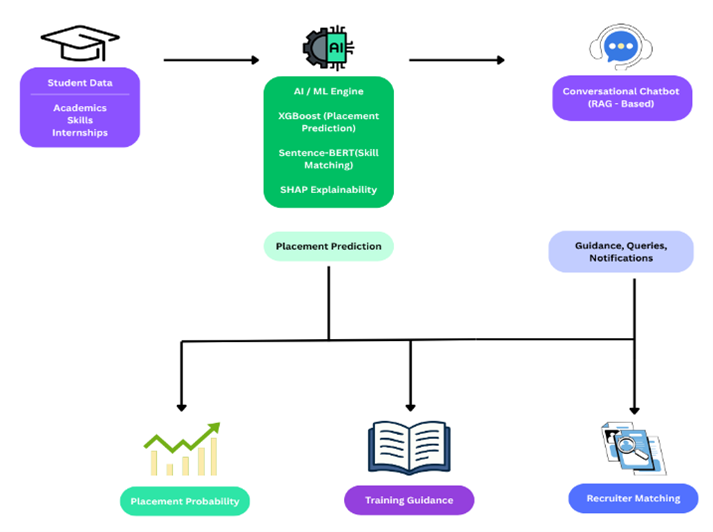
The increasing volume and diversity of student performance data have exposed significant limitations in traditional training and placement systems, which primarily rely on static eligibility criteria, manual shortlisting processes, and delayed communication mechanisms. These systems also lack the capability to leverage predictive analytics, resulting in minimal personalized, data-driven insights to enhance student employability based on individual skills and qualifications.Although several studies have applied machine learning techniques for job applicant ranking, most existing solutions lack real-time integration, interpretability, and conversational support within placement systems.To address these challenges, this study proposes an AI-driven education and placement platform that integrates machine learning-based placement prediction with conversational assistance and intelligent job matching. The system utilizes XGBoost for predictive modeling, Sentence-BERT embeddings for semantic skill representation, SHAP for explainable insights, and Retrieval-Augmented Generation (RAG)-based chatbots to provide real-time guidance and interview preparation support. The platform is implemented using FastAPI and deployed on cloud infrastructure, with automated email notification systems enabling real-time user interaction.The proposed system was evaluated using a dataset of 1,200 student records, incorporating academic, skill-based, and experiential attributes. Experimental results demonstrate an accuracy ranging from 88% to 90%, along with strong performance across multiple evaluation metrics, including precision, recall, F1-score, and ROC-AUC. Additionally, the system achieved low inference latency (<150 ms) and maintained stable performance under concurrent usage conditions.Overall, the findings indicate that integrating predictive analytics, conversational intelligence, and scalable system architecture significantly enhances placement decision-making, improves student guidance, and enables institutions to adopt a more efficient, data-driven approach to managing placement processes.
Keywords:
Graphical Abstract
Novelty statement
An integrated AI-driven placement platform combining predictive analytics and conversationalassistance to enable real-time, scalable, and data-driven decision-making in institutional training andplacement systems.